









What Is the Best Trash Receptacle for a Theme Park? A Buyer’s Guide

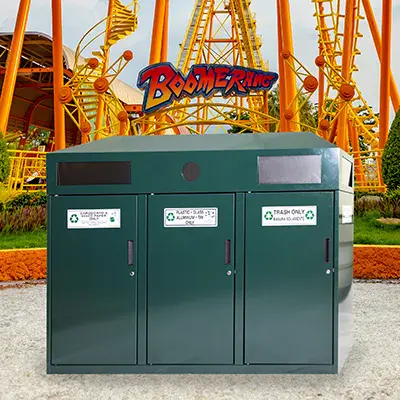
The best trash receptacle for a theme park is a durable, commercial-grade model that matches the location’s waste volume, guest traffic, visual theme, servicing schedule, and wildlife conditions. Most theme parks benefit from using multiple receptacle styles: decorative units in highly visible guest areas, large-capacity receptacles near food service, economical holders in support areas, and animal-resistant receptacles where wildlife or overnight waste is a concern.
Trash receptacles may not be the first site furnishing guests notice, but poorly selected or poorly placed units quickly become visible. Overflowing waste, mismatched containers, difficult servicing, and receptacles that interfere with walking routes can all affect the appearance and operation of a theme park.
A well-planned waste collection system should help guests dispose of trash easily while supporting efficient maintenance, maintaining the park’s visual standards, and standing up to repeated outdoor use. The right choice depends on where the receptacle will be installed and how that area functions throughout the day.
What Is the Best Trash Receptacle for a Theme Park?
There is no single receptacle that is best for every location within a theme park. The best overall solution is usually a coordinated combination of products selected for different operational zones.
For example:
- Decorative receptacles can support themed entrances, promenades, courtyards, and premium guest areas.
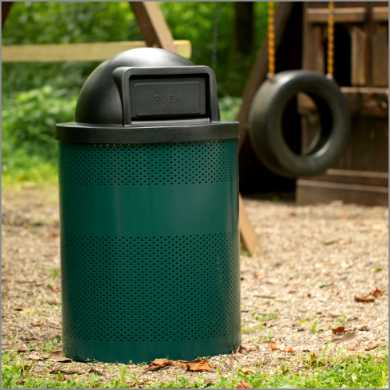
- Large perforated receptacles can handle higher waste volumes near food stands and picnic areas.
- Square receptacles provide a substantial, structured appearance for busy public spaces.
- Trash receptacle holders offer a practical solution for less visible or budget-sensitive locations.
- Animal-resistant receptacles help secure waste in wooded areas, campgrounds, perimeter zones, and locations with recurring wildlife activity.
Before choosing a model, consider guest volume, expected waste type, container capacity, available maintenance staff, visual requirements, weather exposure, wildlife activity, and how the unit will be emptied.
How Do Theme Park Trash Receptacles Compare?
| Product | Best For | Capacity or Compatibility | Primary Advantage | Considerations |
|---|---|---|---|---|
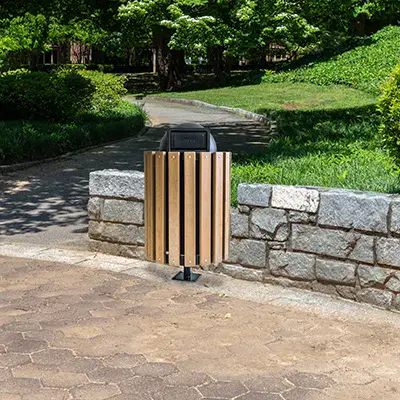
| Decorative Trash Receptacle | Entrances, promenades, courtyards, retail areas, and premium guest spaces | Available in 21- and 36-gallon sizes | Combines waste collection with a finished, guest-facing appearance | Capacity should be matched to traffic and servicing frequency |
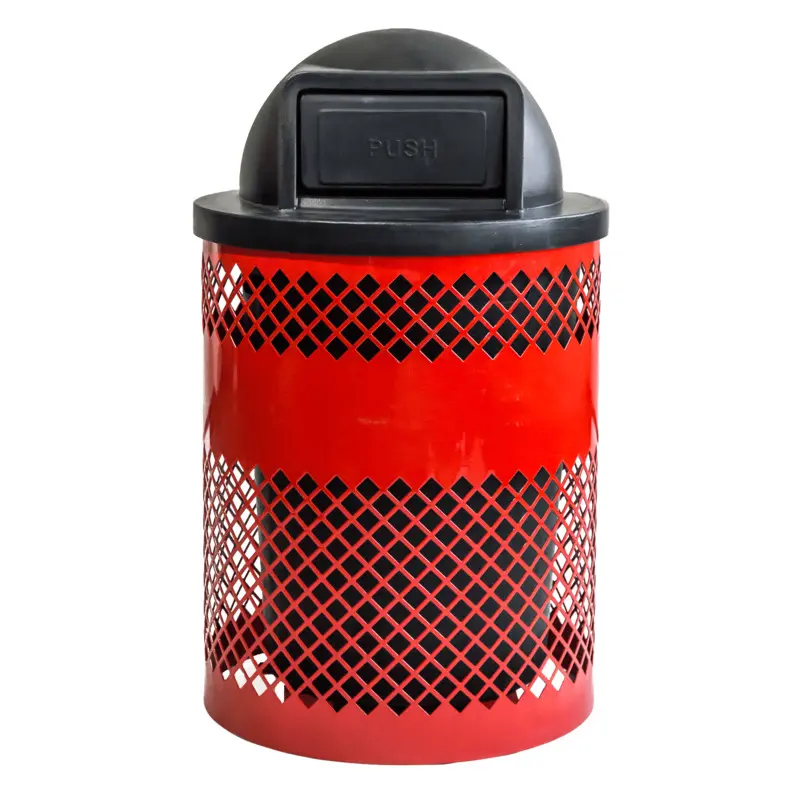
| Diamond Perforated Trash Receptacle | Food courts, picnic areas, attraction exits, and high-volume locations | Designed to cover a 55-gallon trash can | Large capacity with durable commercial construction | Requires enough space for the larger footprint |
| Square Trash Receptacle | Busy midways, plazas, ride queues, and coordinated furnishing areas | Product-specific liner and configuration options should be confirmed | Structured design with four perforated steel side panels and a protective hood | Placement should preserve circulation space around all sides |
| Trash Receptacle Holder | Parking areas, employee zones, temporary layouts, and less visible locations | Fits 32- or 55-gallon garbage cans | Straightforward, economical way to secure and improve the appearance of a standard container | Provides less visual enclosure than a fully enclosed decorative model |
| Animal Resistant Receptacle | Wooded sections, campgrounds, perimeter areas, and wildlife-prone locations | Available in 32- and 64-gallon sizes | Self-latching design helps prevent animals from accessing waste | Guests and staff should be familiar with the latching mechanism |
Jamestown Advanced Products offers Decorative Trash Receptacles in 21- and 36-gallon sizes. Its perforated receptacle line includes a model designed to cover a 55-gallon trash can, while the Trash Receptacle Holder is designed for 32- and 55-gallon cans.
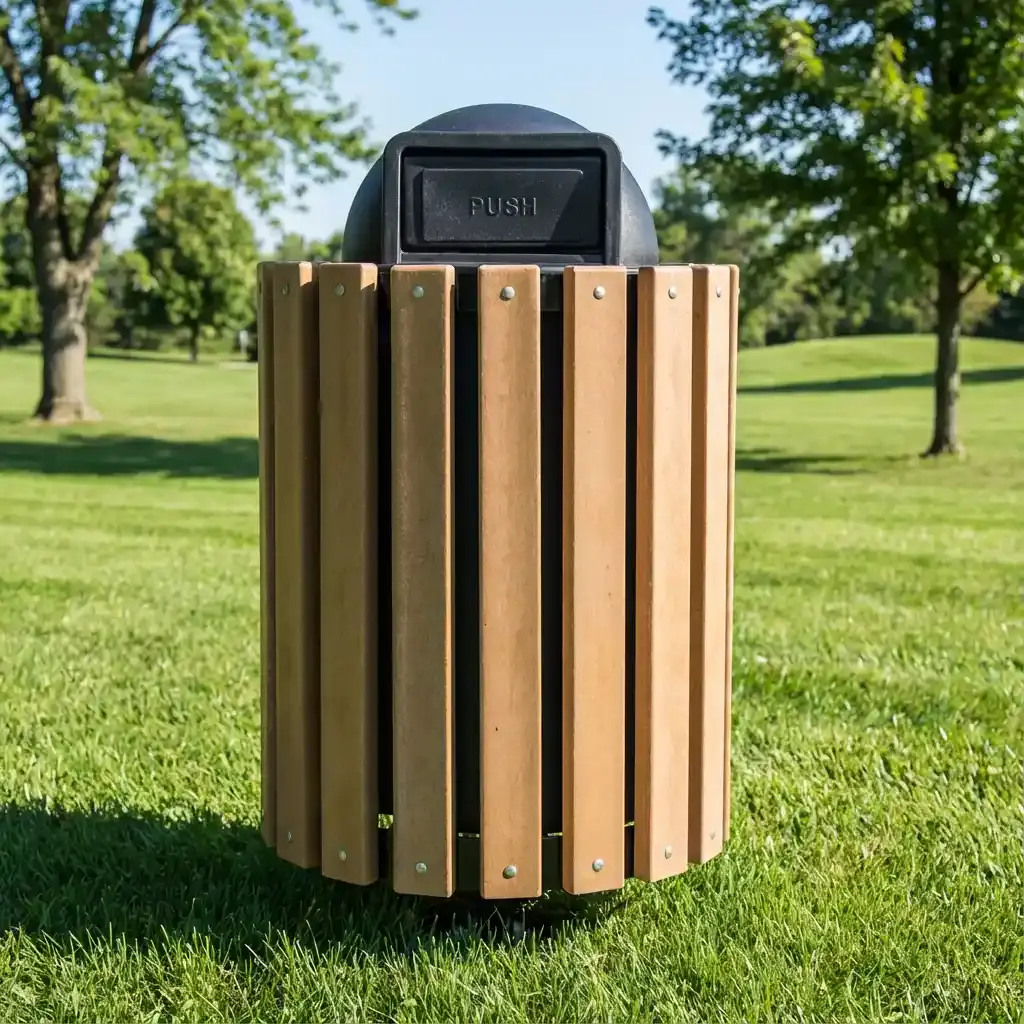
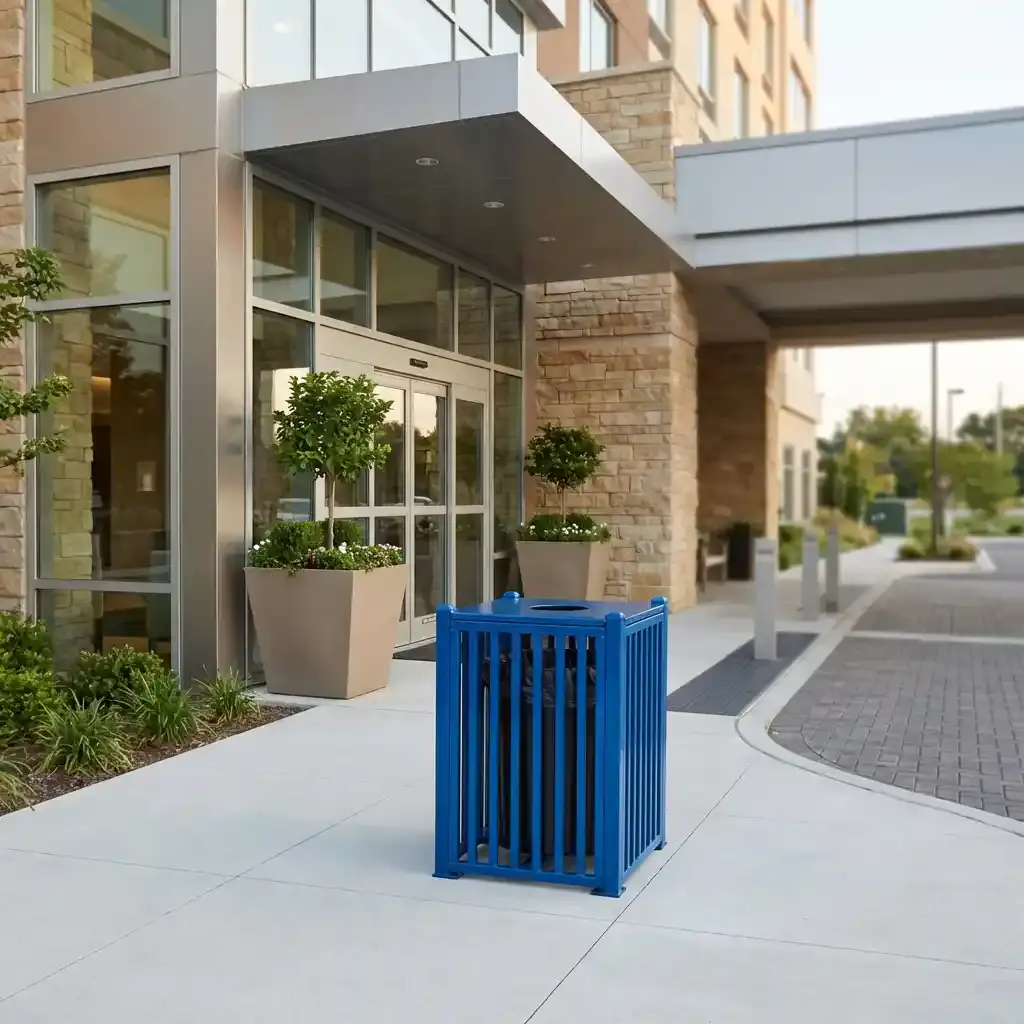
The Square Trash Receptacle is constructed with four perforated expanded-steel panels, vertical corner supports, and a protective hood over the disposal opening.
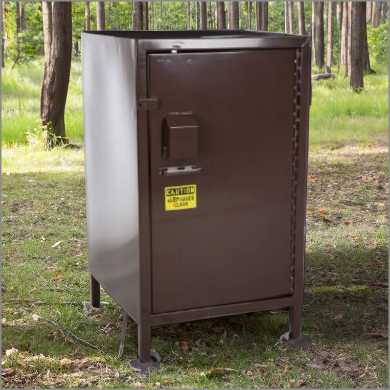
The Animal Resistant Receptacle is available in 32- and 64-gallon capacities and uses heavy-duty stainless steel hinges with an animal-resistant self-latching system.
Which Trash Receptacle Is Best for Theme Park Entrances and Main Streets?
 Best choice: Decorative Trash Receptacle
Theme park entrances and main promenades establish the visual standard for the rest of the property. Receptacles in these locations should feel like part of the landscape rather than an afterthought.
The Decorative Trash Receptacle is well suited for:
- Main gates and ticketing areas
- Guest services buildings
- Retail districts
- Themed promenades
- Hotel and resort connections
- Premium seating areas
- Landscaped courtyards
Its perforated steel construction provides commercial durability while presenting a more finished appearance than an exposed garbage can. The availability of multiple capacities also allows managers to use a smaller unit where space is limited or a larger unit where traffic is heavier.
Custom colors can help the receptacle coordinate with nearby benches, planters, fencing, lighting, and architectural elements. A custom logo or graphic can also reinforce park branding, identify a themed district, or distinguish trash from recycling.
Which Trash Receptacle Is Best for Food Courts and Picnic Areas?
 Best choice: Diamond Perforated Trash Receptacle
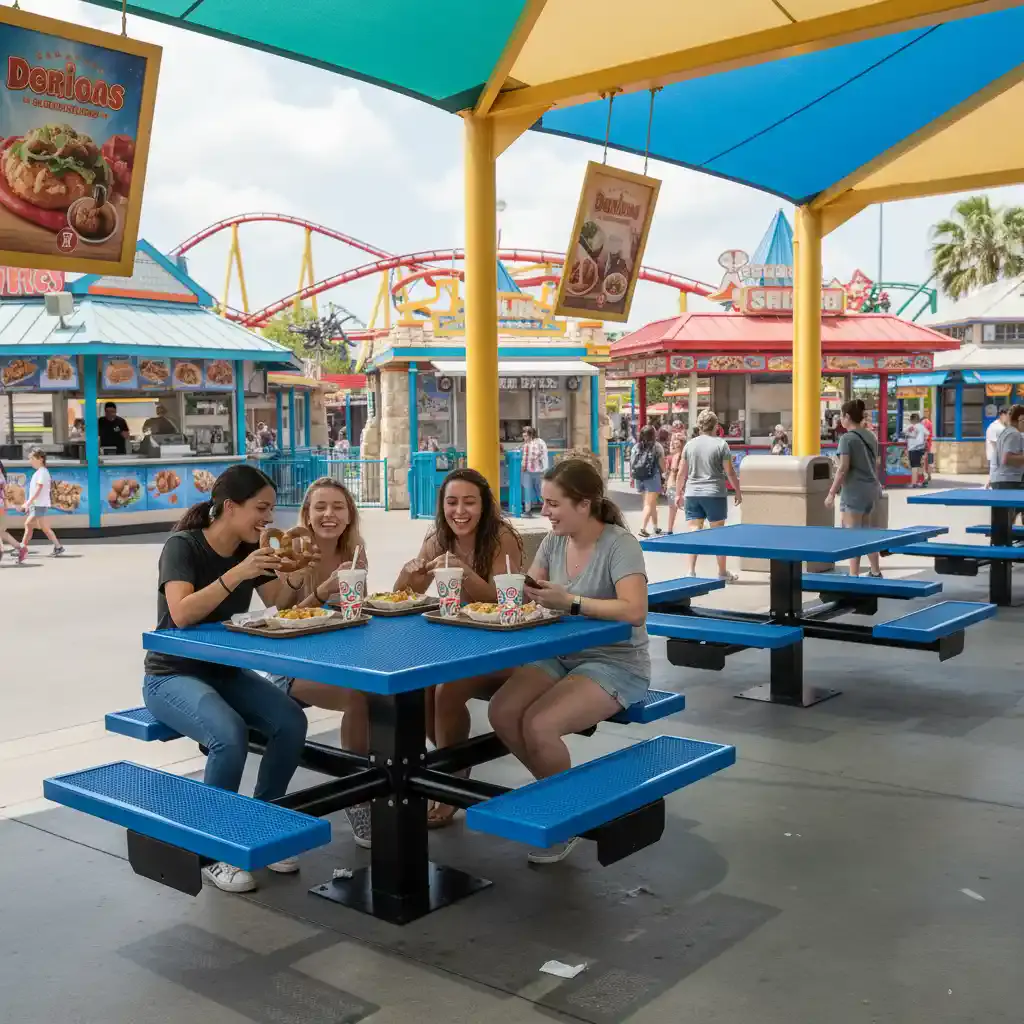
Food courts, snack stands, picnic areas, and outdoor dining spaces typically generate more waste than attraction queues or general walkways. These locations often need larger-capacity units that can handle disposable trays, cups, food packaging, and other bulky materials.
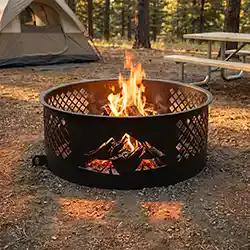
The Diamond Perforated Trash Receptacle is designed to cover a 55-gallon trash can, making it a practical option for high-volume areas. Its perforated commercial exterior improves the appearance of the underlying container while allowing maintenance teams to use a familiar, widely available can size.
Consider placing these receptacles:
- Near food court exits
- At the ends of outdoor dining rows
- Beside condiment and tray-return stations
- Near picnic shelters
- Along the route between dining areas and attractions
- Near group pavilions and event spaces
Avoid placing a large receptacle directly beside a table, bench, or primary photo location. It should be convenient without becoming the visual focus of the space.
Which Trash Receptacle Is Best for Busy Midways and Ride Areas?
A busy midway requires a receptacle that looks substantial, remains visible to guests, and complements other commercial site furnishings. The Square Trash Receptacle offers a defined architectural shape that works well along broad walking routes, near attraction entrances, and in coordinated plazas.
Its four expanded-steel side panels, reinforced corners, and protective hood give it a durable, structured appearance for demanding public environments.
Square receptacles can be particularly effective when positioned:
- Near ride exits
- Outside queue entrances
- At midway intersections
- Near game and merchandise areas
- Beside coordinated benches or planters
- Along wide pedestrian corridors
Because of its shape, the unit can align naturally with walls, pavement patterns, fencing, and rectangular furnishing layouts. Theme park managers should still maintain sufficient clearance around the receptacle so guests do not step into the primary walking route while using it.
When Is a Trash Receptacle Holder the Best Choice?
 Best choice for economical and support-area waste collection: Trash Receptacle Holder
Not every location requires a fully enclosed decorative receptacle. Parking areas, employee entrances, maintenance zones, overflow spaces, seasonal event areas, and other lower-visibility locations may need a simpler way to secure and improve the appearance of a standard garbage can.
The Trash Receptacle Holder accommodates both 32- and 55-gallon garbage cans. This gives theme park operators flexibility to select capacity according to the location without changing the basic furnishing style.
This option may be appropriate for:
- Employee break areas
- Service entrances
- Parking and transportation areas
- Temporary event spaces
- Back-of-house locations
- Lower-volume picnic areas
- Seasonal attractions
- Areas where containers are frequently relocated
A holder can also be useful when a park already uses standardized cans and wants to improve stability and appearance without replacing its entire waste-handling system.
When Does a Theme Park Need an Animal-Resistant Receptacle?
 Best choice for wildlife-prone locations: Animal Resistant Receptacle
Theme parks with wooded sections, campgrounds, cabin areas, perimeter trails, picnic groves, or large undeveloped properties may experience waste problems caused by raccoons and other animals.
An Animal Resistant Receptacle helps secure waste through a self-latching system and heavy-duty stainless steel hinges. Jamestown Advanced Products offers 32- and 64-gallon sizes, allowing operators to choose a capacity based on expected use and collection frequency.
Good installation locations include:
- Theme park campgrounds
- Cabin and glamping areas
- Wooded picnic areas
- Perimeter walking trails
- Employee areas near tree lines
- Overnight event spaces
- Areas with a history of scattered waste
- Locations where trash remains outdoors after closing
An animal-resistant design should not replace good waste-management practices. Staff should continue to empty containers regularly, clean spills, keep doors and lids fully secured, and avoid allowing loose bags to accumulate around the unit.
“Animal resistant” should also not automatically be interpreted as certification against a specific animal species. Theme park managers with formal wildlife-management requirements should verify the exact product specifications and any required approvals before ordering.
What Capacity Should a Theme Park Trash Receptacle Have?
Capacity should be based on actual waste generation, not simply the available space.
A smaller 21- or 32-gallon unit may work well in a premium courtyard that receives frequent attention from custodial staff. A 55- or 64-gallon unit may be more appropriate near a food court, group pavilion, transportation stop, or high-volume attraction exit.
Consider the following questions:
- How many guests pass the location during an average hour?
- Does the area generate food waste or mostly small personal items?
- How often can staff service the receptacle?
- Does attendance rise significantly during evenings, weekends, or special events?
- Will the container hold trash, recycling, or both?
- Are bulky food-service items commonly discarded?
- Can maintenance equipment reach the location without entering guest traffic?
Choosing a larger receptacle is not always the best solution. Oversized units can consume valuable walkway space, become difficult to position, or allow waste to remain in place too long. The goal is to match capacity with both guest demand and the park’s collection schedule.
Where Should Trash Receptacles Be Placed in a Theme Park?
Trash receptacles should be easy to locate at the moment guests are ready to discard an item. Placement is often as important as the product itself.
Prioritize locations such as:
- Food service exits
- Ride and attraction exits
- Intersections between major walking routes
- Restroom entrances and exits
- Picnic and seating areas
- Parking lot pedestrian connections
- Shuttle and tram stops
- Queue exits
- Retail exits
- Event lawns and pavilions
Receptacles should remain outside the primary pedestrian path. They should not reduce accessible clear space, block doors or gates, interfere with queue movement, or force guests to stand in active traffic.
Avoid hiding every receptacle behind landscaping. A container that blends with the park’s design can still be visible and recognizable as a waste station.
Should Theme Park Trash Receptacles Match Other Site Furnishings?
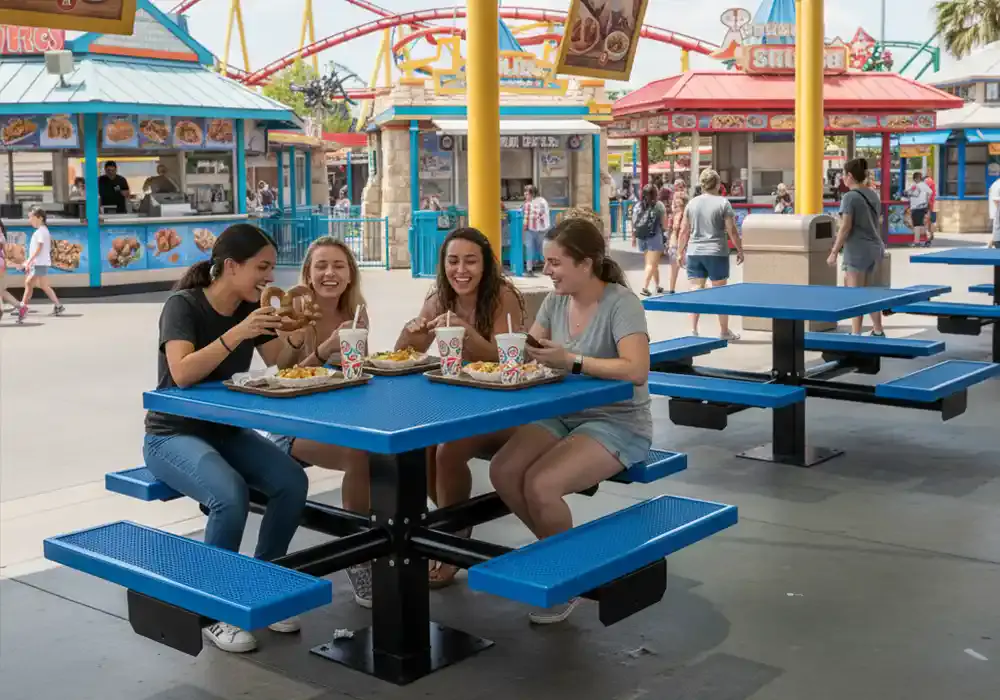
In most guest-facing areas, coordinated furnishings create a more intentional appearance. Receptacles can be selected to complement benches, picnic tables, planters, bike racks, and other outdoor products through consistent colors, materials, patterns, and branding.
Jamestown Advanced Products offers customization services that include custom colors and logos. Its site furnishings are made in the USA using capabilities that include laser cutting and powder coating. Product-specific customization availability should be confirmed during the quoting process.
Theme parks can use customization to:
- Match a park-wide color palette
- Create different colors for themed districts
- Add a park or attraction logo
- Identify trash and recycling streams
- Coordinate furnishings around hotels or resorts
- Match sponsor or event branding
- Replace generic commercial containers with a park-specific design
Consistency does not mean every receptacle must be identical. Different models can still feel coordinated when they share a common finish, logo treatment, or design language.
What Are the Best Trash Receptacles for Different Theme Park Areas?
Best for Entrances and Premium Guest Areas
Choose this model when visual appearance, custom colors, and integration with surrounding furnishings are priorities.
Best for Food Courts and High-Volume Waste
Its compatibility with a 55-gallon can makes it appropriate for locations that generate substantial food packaging and disposable serviceware.
Best for Busy Midways and Structured Plazas
The square profile and protective hood work well in high-traffic commercial environments with coordinated architectural furnishings.
Best for Economical or Less-Visible Locations
Use this option in employee areas, parking zones, seasonal spaces, or locations where an existing standard can needs a more secure and finished installation.
Best for Wooded and Wildlife-Prone Areas
Select this model for campgrounds, picnic groves, perimeter trails, and other locations where animals may gain access to unsecured waste.
What Should Theme Park Managers Consider Before Ordering?
Map Waste-Generating Locations
Review the park based on where waste is created rather than simply placing receptacles at even intervals. Food stands, retail exits, seating areas, and transportation zones may require more units than low-activity walkways.
Review Peak Attendance
Base capacity and quantity on peak periods, not average weekday attendance. Festivals, concerts, holiday events, school trips, and evening programs can significantly change waste patterns.
Standardize Where Practical
Using a manageable number of capacities, liners, cans, lids, and bag sizes can simplify purchasing and maintenance. A park can use different exterior styles while maintaining some internal standardization.
Consider How Each Unit Is Emptied
Maintenance staff should be able to remove bags or liners without awkward lifting, entering guest queues, or dragging waste across dining areas.
Plan for Trash and Recycling Together
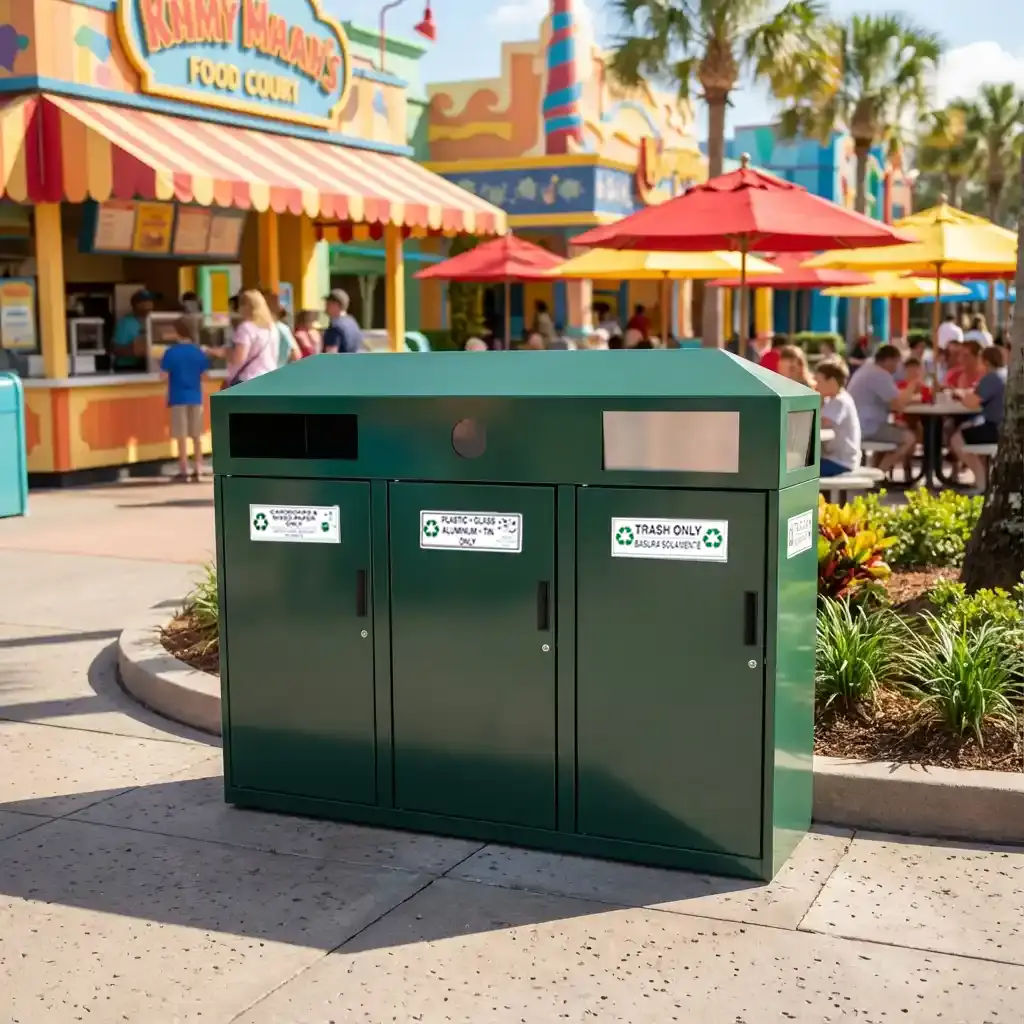
Where recycling is offered, use clear labels, consistent colors, and appropriately shaped openings. Place trash and recycling units together so guests do not have to search for the correct container.
Evaluate Anchoring and Stability
Determine whether each unit will be surface mounted, placed on pavement, or installed on another stable surface. High-traffic parks should consider movement, tipping, wind exposure, and unintended relocation.
Coordinate Finishes With the Surrounding Area
Use colors and styles that complement nearby furnishings and themed architecture. Highly visible locations may benefit from custom logos or coordinated powder-coated finishes.
Review Wildlife Conditions Honestly
Animal activity may vary across the property. A decorative open-access receptacle may work near a busy entrance but be unsuitable beside a wooded campground or remote picnic area.
Check Specifications Before Finalizing the Layout
Confirm dimensions, capacity, lid style, liner requirements, mounting details, finish options, and operating clearances for the specific model being purchased.
What Common Trash Receptacle Mistakes Should Theme Parks Avoid?
Using One Model Everywhere
A receptacle selected for a decorative entrance may not provide enough capacity for a food court. A large food-service unit may be unnecessary in a quiet courtyard. Match the model to the location.
Choosing Capacity Without Reviewing Collection Frequency
A smaller unit can work in a high-traffic area when it is serviced frequently. A larger unit may still overflow if staff cannot reach it during peak periods.
Blocking the Guest Walking Route
Do not place containers inside narrow paths, accessible routes, ride queues, gate clearances, or emergency access areas.
Positioning Receptacles Too Close to Seating
Guests need convenient disposal, but a trash receptacle should not dominate a dining table, bench, photo area, or waiting space.
Hiding Receptacles Completely
Guests are less likely to use a container they cannot see. Integrate receptacles into the theme without making them difficult to identify.
Overlooking Food Waste
Areas selling meals, snacks, and beverages usually need more capacity and more frequent cleaning than areas where guests primarily discard tickets, maps, or small packaging.
Ignoring Wildlife Until a Problem Develops
Properties near woods, campgrounds, or natural attractions should evaluate animal-resistant options during planning rather than after repeated cleanup incidents.
Focusing Only on Purchase Price
The lowest initial price does not always produce the lowest long-term cost. Consider durability, replacement frequency, servicing time, bag compatibility, appearance, and the effect of overflowing waste on the guest experience.
Mixing Too Many Bag and Liner Sizes
Excessive variation can complicate inventory and slow down custodial teams. Standardize internal components where possible.
Why Choose American-Made Trash Receptacles?
Commercial theme park furnishings must withstand frequent use, changing weather, cleaning, guest contact, and repeated servicing. Purchasing American-made products can also make it easier to communicate with the manufacturer about specifications, customization, replacement parts, and project requirements.
Jamestown Advanced Products manufactures durable outdoor site furnishings in Jamestown, New York. Its products are made in the USA, and the company provides custom site-furnishing capabilities such as laser-cut logos, custom colors, and powder-coated finishes.
In-house manufacturing also helps theme park buyers coordinate receptacles with other site furnishings across a broader renovation, expansion, or new-attraction project.
Frequently Asked Questions About Theme Park Trash Receptacles
What is the best trash receptacle for a theme park?
The best receptacle depends on its location. Decorative models are generally best for prominent guest areas, large perforated units work well near food service, square models suit busy plazas, holders are practical for support areas, and animal-resistant receptacles are appropriate in wildlife-prone locations.
How many trash receptacles does a theme park need?
The correct quantity depends on attendance, park layout, food-service locations, waste volume, and collection frequency. Begin by mapping major waste-generating areas and guest decision points rather than using one fixed spacing rule throughout the property.
What size trash receptacle is best for a theme park?
Smaller 21- or 32-gallon units may suit lower-volume or frequently serviced areas. Larger 36-, 55-, or 64-gallon options may be more appropriate near food courts, picnic areas, transportation stops, and major attraction exits.
Where should trash receptacles be placed in a theme park?
Place receptacles near food-service exits, attraction exits, restrooms, seating areas, retail exits, transportation stops, and major walkway intersections. Keep them visible but outside the primary pedestrian and accessible travel routes.
Can theme park trash receptacles be customized?
Many commercial receptacles can be customized with colors, finishes, logos, or other branding. Jamestown Advanced Products offers custom site-furnishing capabilities, although available options should be confirmed for the specific product being considered.
Does a theme park need animal-resistant trash receptacles?
Animal-resistant units should be considered in wooded sections, campgrounds, picnic groves, perimeter areas, and locations where animals have previously accessed waste. They can also help when trash remains outdoors overnight.
Should trash and recycling receptacles be placed together?
Yes. Placing them together makes disposal more convenient and reduces the likelihood that guests will put recyclable material into the nearest trash container. Clear labels, distinct openings, and consistent colors can further improve sorting.
Build a Better Theme Park Waste Collection System
The best theme park trash receptacle is the one that supports the specific location, expected waste volume, maintenance plan, guest flow, and visual environment. In most parks, that means using a coordinated combination of decorative, high-capacity, economical, and animal-resistant products rather than selecting one model for the entire property.
Jamestown Advanced Products manufactures durable, commercial outdoor products in Jamestown, New York. With American-made construction, in-house production, custom colors, custom logos, and multiple receptacle styles, Jamestown Advanced Products can help theme park managers develop waste solutions for entrances, midways, food courts, picnic areas, campgrounds, and other guest spaces.

